Can you install vinyl plank over tile? What we check first
Often, yes. Here is what we look at in your home before saying so, and what it changed on real jobs.
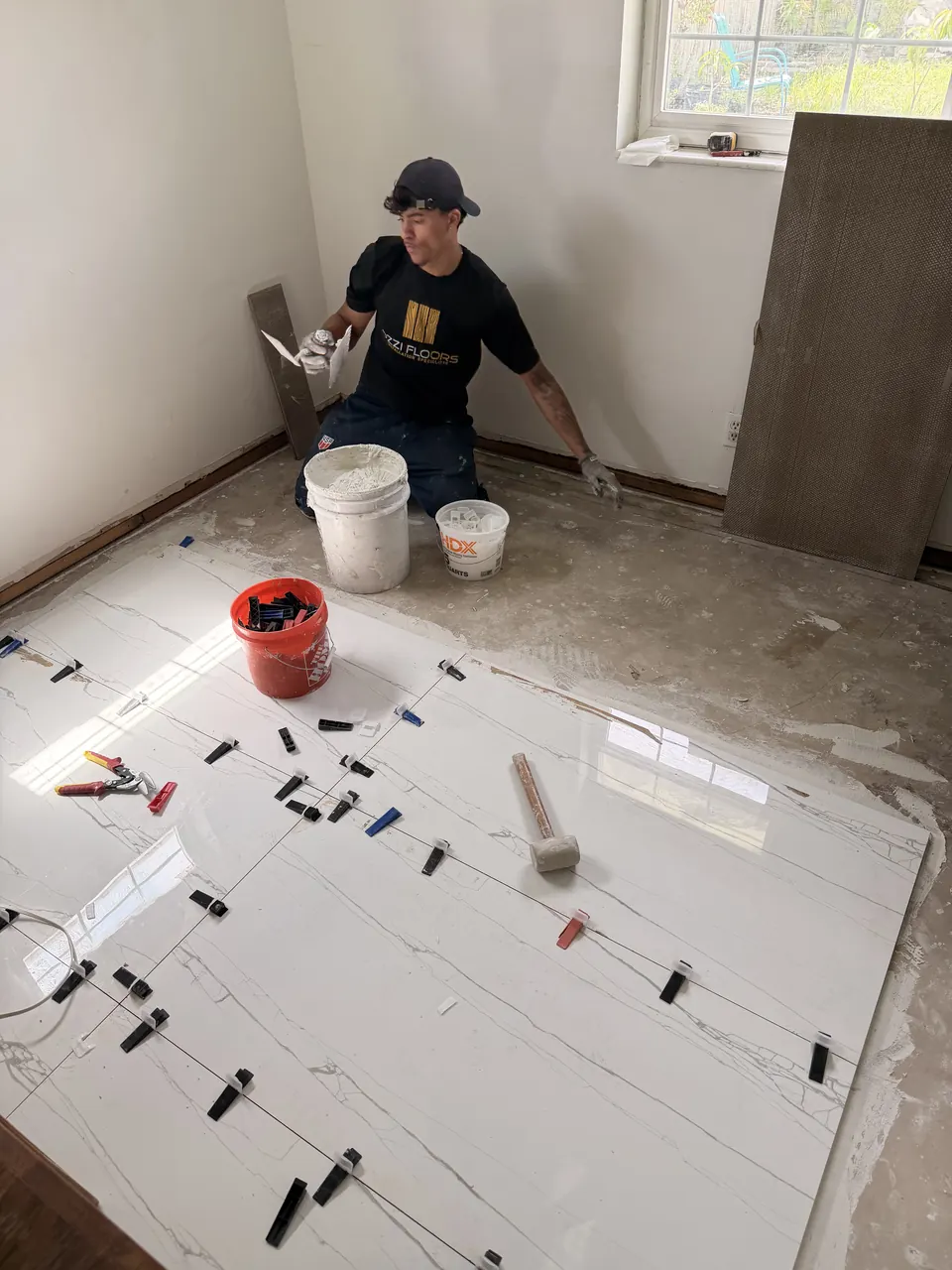
Most South Florida homes we visit have ceramic or porcelain tile somewhere, and the first question is usually whether it has to come out. Rigid-core vinyl plank is a floating floor: the planks click together and rest on the surface below instead of being glued to it. That makes it one of the few floors that can go over existing tile. Whether it should depends on the tile and the house, so this is what our installers check at the free visit, in the order we check it.
What our records say
We keep a written scope for every job. Across our project records, 6 jobs were installed over the existing tile, 9 included a skin coat (a thin leveling layer) over the old floor, and 5 had old tile removed first. In other words, leaving the tile in place is common, but it is rarely just "click it down": the floor underneath almost always gets some preparation.
Two examples at opposite ends: 1,050 sq ft of Plata Oak in Miramar was floated straight over the existing tile with a moisture barrier underlayment, for $4,630 in total ($4.41 per sq ft). 700 sq ft in Hollywood also stayed over the tile, but needed a skin coat first, which was listed as its own line on the estimate ($350.00).
1. Is every tile solid?
We tap across the floor. A tile that sounds hollow has lost its bond to the slab, and loose tiles move under a floating floor, so they are fixed or taken out before anything goes on top. A few loose tiles near a doorway can be repaired; a floor where hollow spots are everywhere is usually better removed. Both can happen in the same house: on a 1,574 sq ft job in West Palm Beach, some old tile came out and that area was self-leveled, while 1,017 sq ft of the remaining tile got a skin coat and stayed under the new floor.
2. Is the floor flat enough?
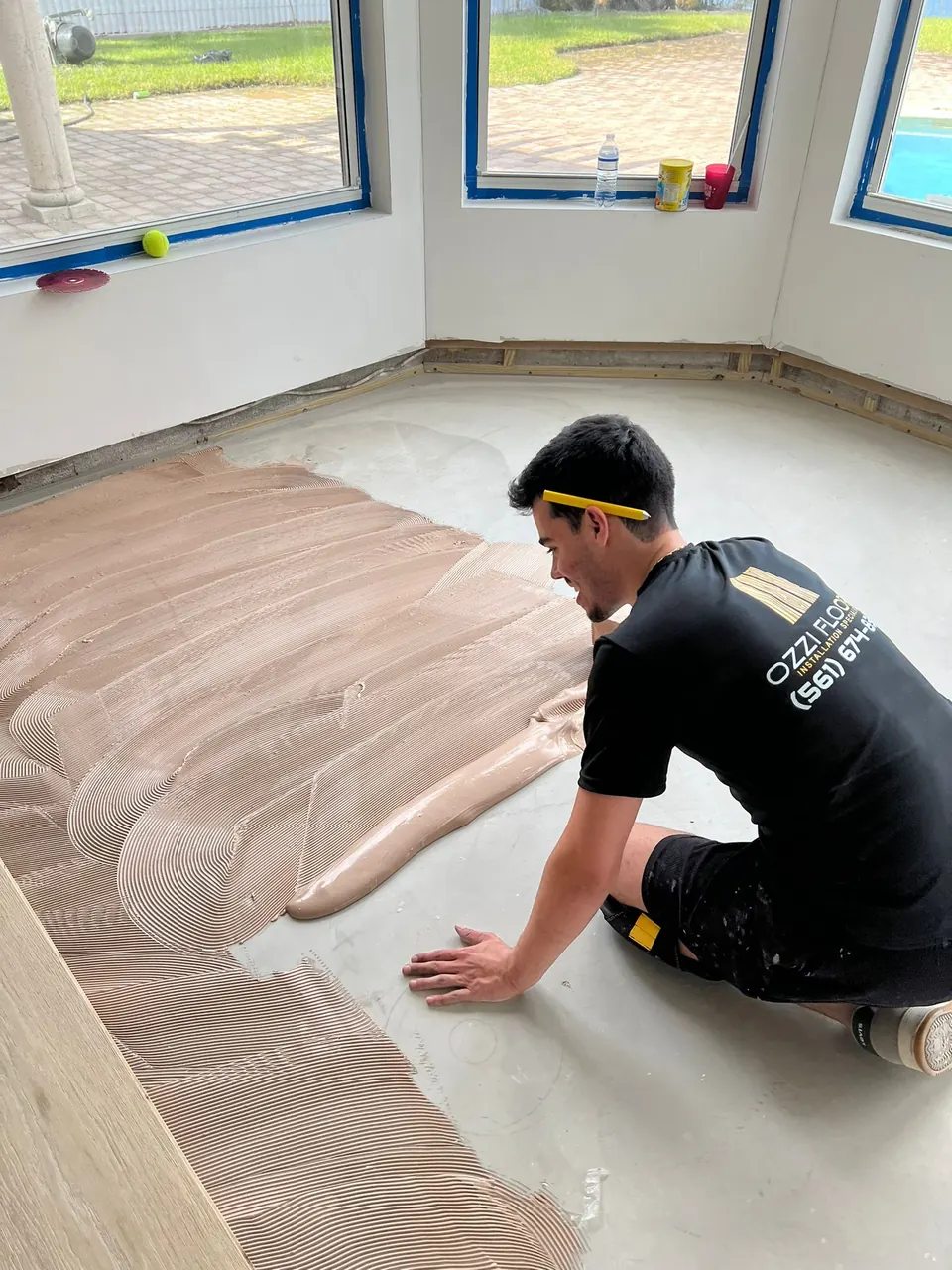
Vinyl plank follows what is under it. Deep grout lines, tiles set at slightly different heights (lippage) and dips in the slab can show through or make the click joints work loose over time. We run a straightedge across each room. Small grout lines and minor unevenness are what a skin coat is for: a thin cement-based layer troweled over the whole tile surface so it reads as one flat plane. On a 544 sq ft job in Homestead, all 544 sq ft got a skin coat over the tile; on a larger 1,648 sq ft job in Boca Raton, 577 sq ft of tile was skin-coated while the carpeted rooms were stripped.
3. How much higher will everything be?
Going over tile raises the floor by the thickness of the new plank (for example 8 mm on Plata Oak) plus any leveling layer. That height matters in a few places, and we measure each one:
- Doors. Interior doors may need a small trim at the bottom so they swing freely. Some of our estimates include door cuts as a line item.
- Transitions. Where the new floor meets a room that keeps its old floor, a reducer or transition molding covers the step. These appear on many of our written estimates.
- Appliances and cabinets. A dishwasher has to slide back out under the countertop, and the new floor has to meet the cabinet toe kicks cleanly.
- Toilets. In bathrooms, the toilet is removed and set back after the floor is down.
If the extra height would cause more problems than it solves, for example one room ending up noticeably higher than the hallway next to it, taking the tile out can be the cleaner job. On a 980 sq ft job in Weston, the kitchen tile came out and the floor was self-leveled before the new vinyl went in.
4. What about moisture?
South Florida homes are mostly built on concrete slabs, and slabs hold moisture. Vinyl plank itself is not harmed by water, but trapped moisture under any floor is never a good idea. Most of our jobs go down with a moisture barrier or a plastic vapor barrier under the planks: 67 of our job records list one. It is part of the installation, not an extra you have to ask for.
Leave it or remove it?
| What we find | What we usually do |
|---|---|
| Solid tile, flat, normal grout lines | Install over it, with a moisture barrier |
| Solid tile, deep grout lines or small dips | Skin coat over the tile, then install |
| Some hollow or cracked tiles | Replace or remove those spots and level them |
| Hollow spots throughout, or the height would not work | Remove the tile and level the slab |
Removing tile is slower and dustier than covering it, and it adds labor, but it is the right call when the tile is failing. Covering good tile saves that step. Either way, the choice and its cost are on the written estimate you get at the visit, room by room, so you can compare before deciding.
What this means for your price
The plank, the installation labor and the baseboards are the same whether the tile stays or goes. What changes is the preparation: a skin coat, some self-leveling, a few repaired tiles, or full removal. On the Hollywood job above, the whole project came to $2,830 ($4.04 per sq ft all-in) including the skin coat and new baseboards. Your number depends on what we find under your feet, which is exactly why we measure and check before we quote instead of guessing over the phone.